Showing posts with label bailey. Show all posts

Wednesday, December 1, 2010

That Damn Clock!

Back at it...researching that clock...

Welcome to the world of picking antiques! Not always fun and games.....lots of homework, too!

So, THE CLOCK:


Well, let's head back to this site.

And hit "Identifying the Maker".

And then: USING TRADEMARKS AND NAMES

Hmmm...well, we know we have the "Bailey" & "18 Chapel St" scratched on the back...


...and that hand written numbered label, but that is it...unless there is something on the back of the movement....which is a distinct possibility.

SO, got to take it apart & take out the movement...carefully!

Will go do that!  If you hear cursing, you'll know I broke something....back in a bit!

And, get out the ointment and bandages, just in case....


*******************************************
Well, no real news to report...not really much farther than before I took it apart...other than it is now apart. I have placed the little bits in a small zip lock bag (always advisable, seeing as parts can disappear easily, and it can he absolute hell trying to find a replacement for some things, even little screws. Save yourself the hassle, bag 'em ASAP.

Why not put it back together? Well, if I want to examine the movement for other clues, I don't want to have to risk damaging it by taking it apart yet again.

I did see more varnish, and did notice that it doesn't have wood stain on the upper sides inside, which is a good sign.


 The back board still seems to be original, but the additional splashes of varnish confirm that it has had some touch up done in the past, and possibly even fairly recent past.


I did notice a worn spot at the bottom of the case, where the bottom of the door rubs, which was stained, and shouldn't have been. (bottom left of photo) 


Sometimes this gets done in a antique shop, before an auction (etc) with scratch cover, but in a case of a piece this old, it is best to leave those true signs of age as they are. You will note the heavy wear on the door's one pillar, down through the original gold coloration, down to the gesso, where someone's fingers has touched that spot over and over, for many years, opening and closing the door, in order to wind the clock.


There is also varnish OVER the wear on that pillar....another sign someone has been "messing" with it, and an indicator to look closer.  This happens to furniture of all sorts, being varnished and re-varnished over its lifetime, but fairly fresh varnish on a very old piece should raise a red flag for you.

Now, this might be a good time to mention a repair that this clock has had done....I am well aware of it, and have been even prior to purchase. In this case, we are fortunate to have been given a "heads-up"....it was mentioned on that post-it-note that came with it! But, I have taken pics of it, as it is something that you may miss if you are not looking for it....good time to learn!

The bottom corner trim on the door was either damaged or missing, and has been replaced.

From the underside, you will notice the lightness of the wood, the lack of "air burn" on comparison to the other portion. The flash really makes this detail prominent, which actully isn't all that noticable in "real life"...not a bad job, but not done by a professional restorer...maybe a clock repair person, but not an antiques restorer.

And, the obvious sign is in the edge....


See the problem? No, no, not the fact the varnish doesn't really match...the flash actually brought that detail out....in regular light it looks darn close to a match. (NOTE: That is a veiled tip....taking a flash photo(s) of an item can bring out flaws, repairs, etc on an item...flaws and repairs you might not have noticed before...!)

So, did you see the other problem?

No?

How about if we compare it with the other side....?


Yep, whoever repaired it, didn't bother (or perhaps lacked the skill or expertise) to replicate the fine carved looping.

I know people who repair vintage items professionally, and if they don't hand carve such an important feature themselves (or have it done by someone else), they may replicated by use of a MOLD, using resin or plaster. They take a rubber copy of an adjacent piece, cast it, then painted/color it to match the other portions.

Watch for that, also!

So, we are not really that far ahead of where we started at the beginning of this post...though you may have learned a few things!

One thing I do want to do a quick Google search for the keywords: "pine case" and american mantle clock.

Yep, figure out what wood it is made of...that will help!

What did I find?


No, nothing pertaining to this clock...but, he had a link to this site:


Where I am going to see if they have a reproduction movement for this one...and see what it looks like...and it will quite possibly give me some information of what clocks they were used in!

Hmmm..this movement looks familiar....here is ours (back view, as well as another view):


But certainly not identical...and ours IS older, for sure....but, I still am a little suspicious of it....Maybe an old repro? 1950s - 1970s?  And, in reality, the newer one is quite different.

The more I look at ours I think it is an older repro. Guess we'll see. Hope not, but we need to be realistic. Its appearance, construction etc, just doesn't seem to jive with the age of the main parts of the case.

If you do come across old (1950s/60s/70s/80s) catalogs that show reproduction parts for antiques, as well as whole reproductions of antiques that were sold in those years, snag them for your research library! They may turn out very, very handy for identifying replaced parts, naturally aged reproductions, outright faked items, etc that you come across!  I already am seeing reproduction signs from the early 1980s popping up on the market with regularity. They appear on sites like eBay, in live antique auctions, flea markets, restaurant liquidations, even estate sales, etc, but are being represented as antiques, usually by the unaware. This occurs simply because the signs have been nailed to a fence outside in someone's yard for the last 25 years...and gotten faded and rusty. 

Rust, fading, scuffs, scratches, bird crap, paint spatters (etc) doesn't make something any less of a reproduction!

Back to our clock....

I'm wondering if there is anything to be seen on the back of the dial, the area obscured under the wood.

Looking at it, I spot another potential problem...yes, the nails are wrong, I already knew that....but the dial seems off center...


Notice the face is off center of the opening...hmmmm.

Now I REALLY need to take the face off of it... *sigh*

Friday, November 26, 2010

Research, Research, Research - Part 3

Well, here goes another attempt to dig further into I.D.-ing that clock.

I took the liberty of going through my own reference materials between the last post and this post, (yes, without telling you..sorry 'bout that!)....and found something!

A Canadian clock book!

But, no sign of this clock.


I decided to check out some of my general guides, one in particular, UNITT'S. I have a stack of older ones I picked up at another dealer's estate sale.  They are handy to have, as they feature much Canadian made stuff, so if I can't find it in an American guide or British guide, sometimes it pops up in an old Unitt's price guide. There are not many reference books on Canadian items...that is, in comparison to the number of publications of books on US, European, and other nations' products.

I did trip across this in 2 of the Unitt's books, oddly enough! It is German made, though...this one has a Union Jack on top, so it was being geared towards the Canadian market.


Recognize it from the previous blog?

Anyway, one of the guides turned out to be a Unitt's Canadian Clock guide (which I didn't remember having), but contained no information on the clock I am researching.

So, I flipped through other Unitt's guides, and found something else I have been researching off and on for a couple years...and happened to have bought at the same dealer's estate auction....


And the previous page's top corner was folded down at that spot!

SO, now I know exactly what they are.  Here are mine:


Had suspected these were "back bar" decanters to begin with, but wasn't 100% sure. I collect saloon related items a bit, and will be building a saloon in the basement of the B&B, so they fit in that scheme of things well. They aren't quite identical to those pictured in the book, but close enough to pin their identity down further than I had prior to this accidental discovery.

I thought they might be for a particular brand of whiskey or other hard liquor, maybe even wine, and have been trying to identify that brand. They still might be meant for a specific firm's spirits, even...more research to do, I guess.  I might offer one, the other or both for sale online yet, we'll see. Have bills to pay!

So, the clock....hmmm....well, where shall we venture....what road shall we take?

Let's go back to that note...


They were way off on what the back said, but, let's attempt to do something with the country of origin...

French or German...ok, let's see where that takes us.

Let's try that antique clock site....and click on "Country."

Germany has less....by a thousand, so let's start there...

Man, I don't know...seems like a fair bit of browsing, and a needle in a haystack, still.

Let's get a new window open, and try Google....

Ok, "German Mantle Clock" and searching by IMAGE.  I like the "Image" feature...handy sometimes.

Hmmm...paging down, down and down....and nothing.

Ok, how about "French Mantle Clock"?

That was fruitless, too...

SO, maybe it is Canadian?

Let's see...."Canadian Mantle Clock"...kind of sparse...very few clocks even pictured...

Canadian Shelf Clock, maybe?  I got 2 images...the same clock...how about you?

Ok, this is getting no where....

Lets try to determine the "era" is was made...narrow SOMETHING down, anyway...

The pattern "carved" into the base and top appear to be machine made.....


Wait....look closer!


Notice anything?

OK, OK, other than my photography skills aren't the best?  Ya buncha smart a****. Harumph....

Look at those two curly-cue things near the round carved bits on the base...and compare them each to the other.


They certainly are different...indicating they are hand carved....and the "hesitation marks" at the bottoms of the grooves of the middle carving and those curly-cues indicate that they were hand carved, also....darn tough to create a perfectly even depth and a curve in one steady swoop of a blade.


GREAT! This bodes well for us!

Now, how about the trim/molding up top?


Hmmm...tough to tell.

I need a pair of calipers....the only ones I can seem to remember where they are happen to be outside in the van...or inside with a pile of junk I cleaned out of the van...going on a hunt....save me one of those beverages you are drinking, would you?

***********************************Time Passes*************************

BACK! I got a cup of tea, a book on Lionel trains...oh, wait a sec...I was looking for calipers, wasn't I?

***********************************MORE Time Passes*************************

Ok, back again...and yes, I have the calipers:...


Happy?  Good....and yes, they are vintage as well...

Down to business...

Let's measure the width of the loops in the molding....

 One...


Two....


Three...


WHOA! A difference in width in this one!

And there is not a repeating pattern of this wider one, either...SO...

The MOLDING is hand carved, also!

Ok, I know, I know, I'm getting a bit over dramatic....and, yes, the gig's up....I didn't need calipers for this myself, I spotted the variations in the widths with the "naked eye"......
But, as you are training your eyes, they come in handy, to prove to yourself you aren't seeing things that you WANT to see that are not there....and to prove facts like this to others who disbelieve your statements. 

And, here is a tip, for those times you have no caliper...for me that is 99% of the time.
Look at the smallest bits of carving...they're even tougher to carve to look identical.
I have marked the areas you need to compare with a bright green "X".


Better to have a trained eye, especially if you tend to forget to bring things with you like I do.

"C'mon, jump through the hoop, boy!  Good, good eyeball, good boy....."

SO, if you are done laughing (or groaning, whichever), we'll get on with the research...

Also, to closely check out the carving and such, especially those little details such as hesitation marks, carry a magnifying glass. A small, inexpensive pocket loupe works fine...just a 10X is good.


Hmmm...you know, we forgot something...to try "American Mantle Clocks" in Google...

Ya should have said something for crying out loud! (Notice how I smoothly passed part of the blame on to you?)

So, let's see how that works...

"American Mantle Clock" as an Image search...

Hmmm...this is sort of like it...

But, this is a different and better quality wood, finger hands, etc...but, the solid glass door, pendulum visible, and a couple other things are alike...let's check it out closer.......

Here is mine/ours:


Side by side, they are much closer than the others....Even the trim ring around the dial is the same...probably a stock item clock makers could order. Note that it has BRASS nails...compared to our replaced steel headed nails.

SO, American,  maybe?  But, can't jump to that final conclusion, yet.

Let's archive that photo in the favourites...there we go....

Looking closer, they estimated it at 25 Pounds - 35 Pounds.

HEY! Did I hear "I doesn't look that heavy!" from the back there?
Ha ha. Very funny...

NO, not weight...that is their currency...their "dollar"..so that is about $50....but, an American clock, no attribution to a maker, selling in Britain might fetch only that, I guess.....but, kind of disheartening, isn't it?   But, that is not OUR clock...ours is a much better piece, right???  And who knows what that one in the British auction actually sold for...

I hope so....let's try to prove it, ok?

Let's check out some more....

Hmmm...after clicking and following a few more dead ends, we still have little to go on....

Well, maybe we can tentatively call it an American Mantle or Shelf Clock with hand carved details....

More than we knew a couple blogs ago!

How about that antique clock site?

Under "Countries"?

USA?

Ugggghh...13,000+ clocks listed...!

Just got a flashback....reading that number made me see a 2 foot high stack of homework from Junior High School...

Well, will pan through it all...and, seeing as that is going to take me quite some time, I'll end the blog here for now!

Research, Research, Research - PART 2

Ok, now, I am no expert in antique clocks.  Normally they sell for far more than I am willing to pay, and almost every time I have bought one, I have not done very well. I have learned things, but sure have not made much money on the purchases. There are SO many things you really need to be aware of, and it is a pretty specialized area when it comes down to it.

But, I know enough to be a little dangerous....more than the average antique auction goer, for sure. But, not enough to be a 100% sure I am bidding on a piece that will make my month. Not very many people do know for 100% sure that they will do very, very well on most pieces they buy at auction. You might have a darn good idea, and odds may well be in you favor, but 100% for sure? 

Not often.

Ok, so you paid a buck for it, fine, it has to be worth $20. But  many items are bought on spec, using the knowledge you do have. However, you might be lacking in certain specialized knowledge, or at least need a reference book to confirm your suspicions....which ,may well not be at hand when you need it.

Oh, those many reference books!

I really need many, many more...but, they are not cheap. I do own 300+ so....and that counts only the price guides, books of marks, and specialized reference books on certain companies, makes (etc) of things. I've also gotten rid of many of my "general" price guides, as most of them are of limited use when it comes to researching items. Values on many things seem to be very out of whack, even in many of the pretty current ones.

Anyway, that 300+ figure does not include the vintage catalog collection I maintain. I utilize that collection to date certain items, identify things, etc....and they number in around that same figure.  Oh, and that number also does not include all the area history books, maps, history books, and a long list of odd books and other paper ephemera that I utilize researching leads, provenance of items, etc.

So, let's say I have 1000+ pieces in my "reference library"...a mere fraction of what I would really like to have....and a tiny, tiny fraction of my "dream" research library.

Anyway, back to the clock...

In all of this material, I think I have ONE clock book.

Problem is, I can't see to find it at the moment.

Not to worry, I am sitting in front of something that gives me access to a very valuable research tool, unavailable to me until the mid 1990s....and getting bigger all the time.

Yep, access to the INTERNET via my computer.

 Surprise, surprise....like you didn't know that already.

SO, let's get started!

I did a quick search for "how to date antique clocks".

And, I found this site: http://www.antiqueclockspriceguide.com/

Cool!

One problem is to get access to certain information, you need to sign up...a paid membership of some sort, by the looks of things.

But, there is some limited access to some useful info.

Oh, did I mention there was a label with the clock?

No, not a maker's label...but a Post-It-Note....


I am always wary of these things...they are "here-say." I always try to take these little hand penned notes with a grain of salt. It is pretty easy for anyone to write whatever they please on a piece of paper and stick it with the item that is being sold.

"This was great, great Aunt Ethel's, and hung above her bed for her entire life until she died at 112."

Yes, they might contain accurate family history, provenance, real knowledge, etc...but, rely on YOUR knowledge to prove the statements in them true (or false).

They might only be partially correct, if the information has any basis in fact at all.

Heck, it might even be a note that is 100% accurate.....but was not meant to even GO with that item!

So, let's look at this one. It appears to read (in italics):

B137 (with a modern sticker with the same number on it stuck beside that)

PaiLey
     ChapeLed

Winding arbor broke
Piece of wood missing
Small clock works
More than likely French
or German. L over
100 years old.

I read this, and went, OK, SURE...Um, let's just think about this for a bit....

Ok, say that "Pailey Chapeled" is actually the maker, and not the previous owner of the clock....

What the heck...I did a search for that.

Nothing. No surprise there, really.

So, I carefully looked for a label, one of the other reasons I had taken the panel holding the face off in the first place...to try to identify a maker.

No luck there.

I had also seen the label on the back, which is maybe a model number. A piece of one corner has broken away, which was a good sign for age...the wood underneath wasn't heavily "air burnt"...the wood panel is at least old, and the label has been on it for quite some time. Looks like the corner of the label broke off some time ago, also, as that exposed portion has darkened, also, but not as much as the surrounding surface. Ok, back is quite likely original to the cabinet!


But, no maker's marks....oh, wait a second!

When I looked at the back, I noticed some indenting I had mistaken for scratches.

And I saw where "Pailey Chapeled" had come from....


See anything?  Here is one on its side..might be easier to see now...I have also adjusted the contrast a little in my photo editing software program.

I know, really tough to see. But, it does appear to say Pailey Chapeled...

But wait!

I looked more carefully at what was crudely scratched into the back, and what I finally saw and recognized was:
 BAILEY
18 Chapel St.

AH HA!

Now we have something, me thinks!

The scratching also is not recent. The wood's patina in the denting of the scratches is identical to that of the surrounding wood.  Looks like it has been there since the clock was made...or added darn recently after. 

Still could just be a previous owner...maybe the first owner.

But, might be the maker...so, let's get online!

I use Google the most. Best overall search engine, in my opinion.

But, we did find that clock website, so let's try it first, searching by maker.

I'll try BAILEY.

Hey, yes, under the B's we have some BAILEYS!

But, unless we pay for access this is almost the end of the road....But, we can access photos of some of the clocks these different "Bailey" companies made...so let's do that.

Bailey, Banks and Biddle....hmmm...nope, not all that likely, but who knows what other types they made.

Bailey, Putnam....well, I suppose they are wood....I dunno...maybe...

And, that is it for Bailey...and there is Bailly, but this one definitely reads BailEy.

Well, lets see what else we can glean at this site...


No "No. 849" that I can see...no Bailey, either....If that is the name of the maker, maybe they only used model numbers, no names?

Let's hit Google for a second...

Actually, let's check out the "Clock Types" on this site first...if we can nail down what this style is called, hopefully we can narrow or Google search a bit...

Let's see..what could this clock be called? Here is a pic, for reference:


Column? Not quite...this measures a mere 14 1/4" high....and the ones that are shown I know from what I have seen in similar clocks over the years are almost twice that height....but, there are 57 pages, and need to check 'em all.....ok...be back in 57 mouse clicks! Oh, also, instead of just looking for "this clock", you should be looking for similar base styles, face styles/details, top styles, pendulums, etc...not necessarily just this the exact clock! Those details may lead you to the maker, also! Plus, I think this will just be a long list of any clock utilizing columns in their design..but, this one has columns, so let's look...

Page 17 Well, a clock similar in the style of this one...and likely similar in size...but that is about it...
And they call it a Bracket Clock....so, we have a "type"... I would have said "Shelf Clock"...so I guess I was close, I suppose some would say they are one in the same. Yes, I figured that is what it was called already...and yes I was close...but I didn't know for 100% sure....so why confuse you? Plus have to let everyone else figure it out...can't reveal ALL of what I already know now, can I?  Besides, now you know another way to find out what the style is called.

Let's pop open another window, and open up this same site to the main page...just for giggles.

And go to Makers again...

What was the make of that one Bracket Clock again?

Oh, yeah...started with a J....Junghans....

No, not Jughead! Put your Archie comics away please, students!

Let's see....oh geeze, 289 clocks to look at...*sigh*...oh well, let's scan 'em...

OOOO...couple of these look interesting!  Ok, for those of you who have gotten distracted and are checking out all the other wild clocks....HEY, FOCUS HERE!

This one!

Ah, maybe not...but, we are in the right ilk, anyway...keep lookin'...

OOOO..this is cool!

Oh, yeah, right, I am working here....

So, 16 pages and nothing close...well, a few vaguely like it.  I think this one is not the same quality of Junghans. They've been around since the 1860s and are around still, making watches. Worth doing some reading later...some of their more modern stuff might well be worth watching for.

So, lets keep looking for the maker of our Bracket Clock. Oh, and Bracket clock does not actually define ours accurately...judging by the definition. This one sure has no place it ever had a handle...oh well, we'll still go with the same term...well, I suppose it is more likely and better defined as a "Mantle Clock" or "Shelf Clock"...

Oh yeah, that is what I had said, wasn't it ? (as I pat myself on the back...)

Ok, lets keep clickin'...many pages to go yet...

You know, we could have gone straight to "Mantle Clocks"....Oh wait, there is no "Mantle Clocks" section...but there is "SHELF CLOCKS."

But omigawd....over 740 pages....I don't think I am up to clicking that many times...No rum to ease the monotony and carpel tunnel I will eventually develop after 300 clicks...

Well, maybe a few...?

Ok, maybe not...my time is worth more than that....

So, let's try to narrow this down, seeing as we are not getting far....

There was a neat little thing we could use in a search on Google...the street address!

Let's see where that gets us...

Yikes, tons of results...let's narrow it down a bit...

Interesting...but, nothing solid...no clock makers right at that address.

Maybe "clockmaker" as one word?

Even more dismal results...

How about "Bailey" & "18 Chapel St"?

Lots of results....too many...

How about "18 chapel St" "Bailey lived at"?

Ooops, too specific...

Hmmm...so, we know there are tons of Chapel Streets in the world...in England, Australia, US and Canada. and who knows where else....

A dead end?

I guess we'll have to see after I eat...yep, that is it for now....!

Research, Research, Research.


I was just starting to research a piece I picked up on the weekend at a local auction and I got thinking that maybe you'd like to come along for the ride!

Research is a required skill in this business. It can make the difference in being able to justify pricing a piece at $50 or $500 or $5000.

So, I thought I'd bring you along on the road I am taking while researching an antique clock I bought.


Nice, eh?

I bought it on spec, without really examining it very closely first...which is a mistake!!!

 ALWAYS examine items closely before buying!  Go to that auction's preview, spend the time checking things closely!

When I got really examining it, I realized I really could have goofed had I payed more than the $67 I did pay.  My years of experience tell me that as a decorator piece I could get $100, maybe $150, but if that is all it is worth, I will consider it a bad purchase...yeah, I can get my money out, more than likely, and maybe even make profit, but I bought it thinking it had potential for much more. A touch of auction fever...induced by a previous purchase...which is a completely different blog...coming up soon!

That said, in the money conserving/strapped for cash mood I was in, I would  have likely stopped after another bid or two. Had I been flushed with cash....well, who knows what I would have done.

If nothing else, I am (and you are) about to learn, be educated....which could end up being worth what I paid for the piece....by assisting me in my assessing (potential) values of other clocks I come across using the knowledge gained by having to research this piece.

So, it won't be a total loss, even if it turns out to be nothing great.  You will have gotten this education for free...or, at least, for your time reading, and at my out of pocket cost.

When I bought it, I was kind of excited...it has all the indicators of some decent age.  Nice patina, what appears to be a hand painted dial, very heavy wear on the gold on the columns on the door, the glass is wavered and has small bubbles, and overall just has a certain "look" about it.


It has sat on one of our bookcases by the fireplace for 4 days now, and I have looked at it off and on. After that period of time, the "excitement" of this fresh purchase has worn off, and I am getting far more critical of it.

All sorts of things are jumping out at me as "wrong" now.

One of the things I noticed right off, even just after purchasing, is that it is missing a piece of hardware that makes sure the weight of the pendulum doesn't fall off.....there is a piece of bright, shiny copper wire wound around the shaft to replace it.  You can even see two spots of solder where the piece had been soldered in place.


"So what?" I had figured. Well, normally, it would have said to me LOOK CLOSER, DAMMIT.

Also, something else has also been niggling in the back of my mind is the trim ring around the face.


It is just too bright, too crisp. Nail heads holding it in are also crisp & shiny, with no patina. This piece appears to be over 100 years old, so the nail heads should more than likely have oxidized, darkened, or even obtained a little rust. Though, I should note, rust doesn't determine age. Rust happens literally overnight if the conditions are right.

But, true PATINA, on the other hand, can not be obtained overnight.  Patina, by the way, is the coloration/oxidization a surface obtains due to age. Wood darkens with exposure to air, as an example.

My thought is the trim ring has at least been replaced, or in the least, and I am thinking more likely, removed and cleaned heavily, with modern nails used to put it back in place.

I also noticed scratches, and what seemed to be fairly fresh scratches, around the screw heads/holes holding the wood panel that is holding the face in place. 


Due to these scratches, I have been wanting to take a look at the movement ever since I got it home.  I've been worried someone had put some modern movement,a repro movement or just made a heck of a mess inside.  A modern movement was unlikely, as I could tell it was likely a period correct style movement, as the shaft holding the hands was square, and the way the hands mounted in place also seemed correct. But, someone could always have done some adapting...epoxy is a popular product.

So, I unscrewed the face, and removed the screws...Before I even removed them, I noticed that the screws were both different.


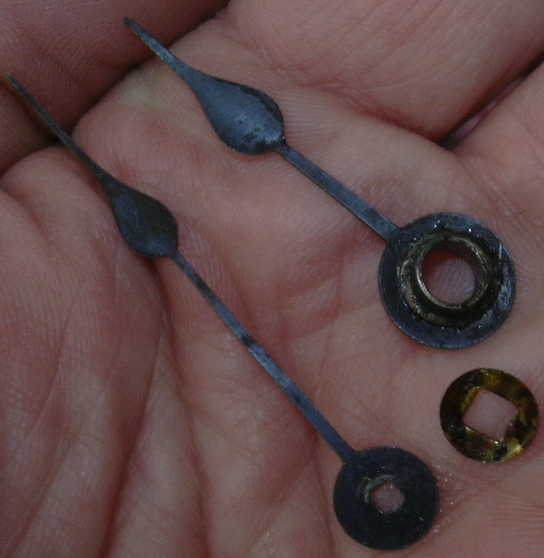
To remove the panel, I also needed to remove the hands.


These are kept in place with a thin, tapered rod, pushed through the square shaft.  So, I pulled this out, and did it with my fingers. Hmmm...Usually these are fairly tight, having obtained some corrosion, gunk, etc over the years.... and you usually need a pair of pliers.

So, as I removed the hands, I immediately noticed something else I really should have taken more notice of before..I did notice it, and dismissed it as unimportant, though it really was important.

The brass ring that was over top of the hour hand has a square hole that is way too big for the shaft size.  So, if this is the original ring, then the movement has been replaced. Or, hopefully, and preferably, the ring itself is a replacement. Cross you fingers!


So, after I removed the panel, my heart sank...as the first thing I spotted was a bright, clean movement and 4 slot headed screws holding it in place, whose heads are bright and shiny.  Normally shiny things attract people and make them happy....not the case in this business! I wanted to see a very dirty movement, screws with many years of dark patina, grunge around the mounting points of the movement from dust, oil and debris, etc.

If I had looked at the clock closely before buying, I'd have seen that the lower two screws were recent (see view in second photo.)


After a closer look at the movement, I have (currently) decide that it is old...but has been heavily cleaned up.

The screws holding it in place are not original, not by a long shot. Could have been put in just last week they are so crisp & new.

But, on a positive note, there are no other visible screw holes, which would almost positively indicate that the movement has been changed. I suppose this movement could be an accurate reproduction, but for now, considering the hand stamping of the number on it, and the way the one gear is kept in place, I still believe it is old....but, the little brass wire holding that gear might be the repair person's "make do" for the part they lost or was missing.


Another thing that concerned me is that the wood is stained inside behind the movement....where you can not see when the face and panel are in place...not so sure this is "right."  How many dresser drawers get stained on the inside by the makers?


So, I have put the face back in place, did more pics in order to post it online, either auction (yeah, probably eBay, as much as I'd like to avoid posting there) or at a set price on http://www.addoway.com/, or maybe to send to a clock dealer or collector if it is worth offering it to them, at a set price...if I can determine an accurate value.

So, that is where I am at right now...need to do more research.....

And that is what the next blog will be about! Coming later today or tomorrow!